Common Sense Ethics
  • Blog
  • About
  • My Books
  • Parenting Resources
  • Personal Growth Resources
  • Book Summaries
  • Contact Me

This One Idea Explains Most of What is Wrong With Politics

9/21/2020

0 Comments

 
Picture
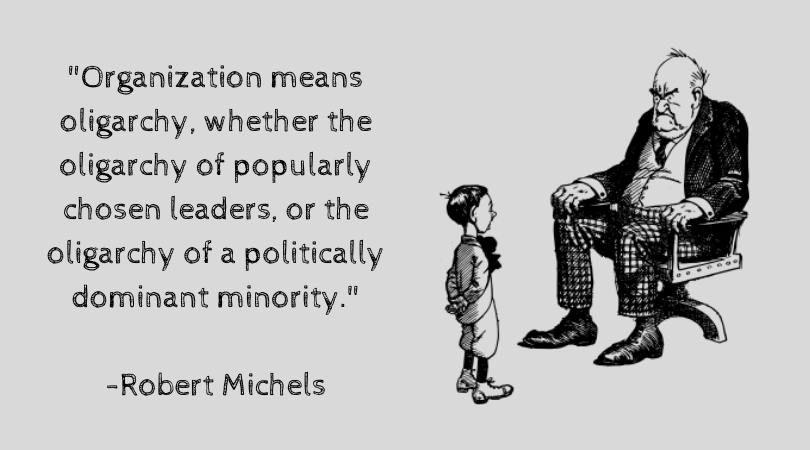
Why do governments tend to become more corrupt over time? It turns out that the best answer to this question may have been floating around for over 100 years, and I think everybody should know about it. 


“Who says organization, says oligarchy," states Robert Michels, a German historian who produced one of the most scathing assessments of government ever written. He argues that bureaucracy and democracy don't mix. Michels is best known for the ingenious Political Parties: A Sociological Study of the Oligarchical Tendencies of Modern Democracy, published in 1915. The book positively begs us to examine the maxim that power corrupts, and to seriously consider if democracy is nothing more than a idealistic impossibility. 
​


Oligarchy is defined as rule by an elite or privileged few. Today people often use the word oligarchy to refer to a leadership class of corporate plutocrats, but what is less understood is how oligarchies form. Oligarchy is rule by a few to be sure. However, the concept of oligarchy in Michels' lexicon - the “Iron Law of Oligarchy,” - is both an explanation for how oligarchies originate, as well as a compelling critique of the inherently flawed structure of all forms of democratic government itself.  
​


Read More
0 Comments

What is the Purpose of Government?

8/29/2020

0 Comments

 
What is the purpose of government? We all can define the purpose of medicine or of car repair and so forth, but with government, the purpose is undefined.

We wouldn't tolerate our doctor or mechanic talking to us in the way politicians do - never addressing the details of the problem, running away or becoming hostile when difficult questions are asked. So why do we tolerate it in politics?

This discrepancy indicates that we haven't defined the purpose of government well enough, which is the focus of this Socratic dialog. 

Support the channel: https://ko-fi.com/commonsenseethics
0 Comments

How to Change Your Mind

7/3/2020

0 Comments

 
The Socratic Method is a way of thinking which helps you to become more open-minded and less afraid of being wrong. Socrates felt that we are more ignorant than not, so to achieve excellence, we can’t be satisfied with what we already know, we should keep striving to gain knowledge and get closer to the truth.

Changing your mind is more Socratic than dogmatically clinging to your beliefs throughout life. But it's not always easy to do, and that is what I discuss with my guest Justin Vacula.
​
We cover the important point that free speech - even controversial free speech - is essential for true critical thinking and for Socratic Dialog and therefore must be protected. Without free speech, we have what happened to Socrates himself - he was imprisoned for speaking freely and committed suicide. Human knowledge cannot be advanced without open discourse, without which, we remain in ignorance.

Support the channel to see even more videos like this: https://ko-fi.com/commonsenseethics


Read More
0 Comments

How to Do Socratic Dialog: What Is Justice?

5/25/2020

0 Comments

 
Socratic Dialog (also called the Socratic Method) is a way of working together to discover the truth and test whether your ideas or opinions are sound. The Socratic Method is also a way of thinking which helps you to become more open-minded and less afraid of being wrong. 

In this video my guest, Max Maxwell, explains Socratic Dialog and demonstrates how to engage in Socratic conversations with an open mind as we discuss justice and the purpose of government. 

The Socratic Method is especially important today since political discussions are often so polarized, and people tend to act in a less than charitable way when discussing issues that they disagree on.
​


Read More
0 Comments

Parents! Cut Yourselves a Break

2/16/2019

0 Comments

 
Welcome Holly Hamilton-Bleakley, a philosophy professor and mother of six, to my YouTube channel! Holly is the author of the wonderful blog, Philosophy For Parents.
Here she shares wisdom gleaned from 20 years of motherhood and her extensive knowledge of philosophy. 

​We discuss:
  • The difficulty of becoming a parent for the first time.
  • How to best handle the challenges of parenthood. 
  • The strengths and virtues necessary for being a good parent.
  • How to slow down and cut yourself a break when you have little kids. 
  • Dealing with the feelings of impermanence that parenting brings.  
  • How the issue of raising children is ignored by most Western philosophers, and more.
​
You may also like:
Creating Your Ideal Family Culture
Fearless Parent: How to Raise Kids Using Stoic Philosophy 
Apply the Antidote: Teaching Kids to Deal With Problems 
0 Comments

Fearless Parent: How to Raise Kids Using Stoic Philosophy

8/12/2018

2 Comments

 
Wondering how to be less stressed as a parent? Stoicism is an ancient Greek philosophy that teaches us how to focus on what we can control in life. Brittany Polat of Apparent Stoic and I discuss how to apply Stoic philosophy to parenting, and how it can make both parents and kids happier.

We discuss:
  • Overcoming worry and parenting anxiety. Not worrying about what other people think of how you raise your children.
  • US culture being oriented towards adult lifestyles and careers and not very child friendly.
  • Thinking that you can control everything and being goal oriented does not work with kids because while you can influence them, you can't control what they do.
  • You will be happier as a parent/family if you focus on what you can control - the environment, how you respond, getting prepared in advance, etc.
  • The Golden Rule and other ways to teach kids the value of kindness. ​
2 Comments

Video: The Best Philosophy Books For Beginning Readers

5/17/2018

0 Comments

 
Which philosophy books are the best for people just starting out? Dr. Greg Sadler and I talk about his recent list of the 10 Best Philosophy Books for Beginners, which is now one of the most popular posts on this site. 

We dicuss:
  • Which thinkers are average people most interested in?
  • The practical philosophy movement and popular philosophies like modern Stoicism and Aristotelianism that are currently being applied in people's lives. 
  • Philosophy's relevance: the disconnect between academic versus applied philosophy, poor outreach among academic philosophers and the public.  
  • Women philosophers - Greg's love of Mary Wollstonecraft, and why some people argue that Aynd Rand is not a philosopher.
  • Avoiding agenda-driven histories of philosophy and the importance of reading primary texts. 
  • Poor pedagogy in introduction to philosophy classes - the difficulty of teaching, good versus bad teachers.
  • Existentialism: reading books of philosophy as a teenager and then again as an adult. What appeals to people? 
  • Interesting tidbits about Anselm's On the Fall of the Devil and many other books. 
​
If you like these types of videos please subscribe to my Youtube Channel. 
0 Comments

The Happiness Triangle: Stoic Secret for Peace of Mind Video

3/18/2018

7 Comments

 
What 3 things are necessary for happiness? Leah Goldrick of http://commonsenseethics.com interviews Jonas Salzgeber of http://njlifehacks.com about how to become a tower of strength through Stoic philosophy. (Please note that if you have difficulty hearing the audio, click the "CC," button on the lower right of the Youtube screen to enable subtitles). 

We dicuss:
​
  • Doing your best/focusing on the process of growth and developing virtue, rather than the outcome.
  • Is self-compassion missing from Stoic philosophy?
  • How much do externals/prefered indifferents matter? Is Aristotle correct that we need some externals to be happy or are the Stoics correct that only virtue is necessary for happiness?
  • Is the Sage a realistic role model?
  • What is eudamonia?
  • Jonas' new book
7 Comments

You Must Master the Media or the Media Will Master You

6/13/2017

0 Comments

 
Picture
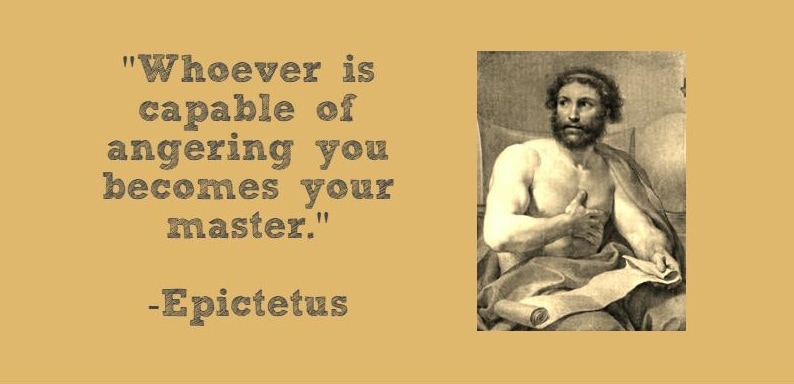
Being angry or depressed over news, politics, Donald Trump and so on, is extremely common at present. Emotions can be useful - they often tell us when something is wrong. But when we are angry or fearful we can't think critically; we just react. It takes intellect to actually break down information piece by piece (critical thinking) and find solutions. Emotionalism overrides proper intellectual process. 

Even worse, when we allow ourselves to get upset or angry, we are no longer in control. The Stoic philosopher Epictetus reminds us that "Whoever is capable of angering you becomes your master."
We can either master our response to information in the media, or allow it to take control of us via our emotions. 

I'm a big fan of Lenon Honor and his work on positive relationships and raising emotionally healthy families. While listening to his channel on Youtube, I was struck by the Stoic overtones in this video (embedded below) and the similarities to my media series, especially 4 Pieces of Stoic Wisdom for Dealing With Negative News Media. While I wouldn't call him a Stoic, Lenon certainly has some philosophical things to say. Technically the video is about race, but overall it's about emotions and dealing with negative media and the subject matter is relevant to everyone. Give it watch!


Read More
0 Comments

Fake it Until You Make It: Aristotle on Becoming A Better Person

4/1/2017

4 Comments

 
Picture
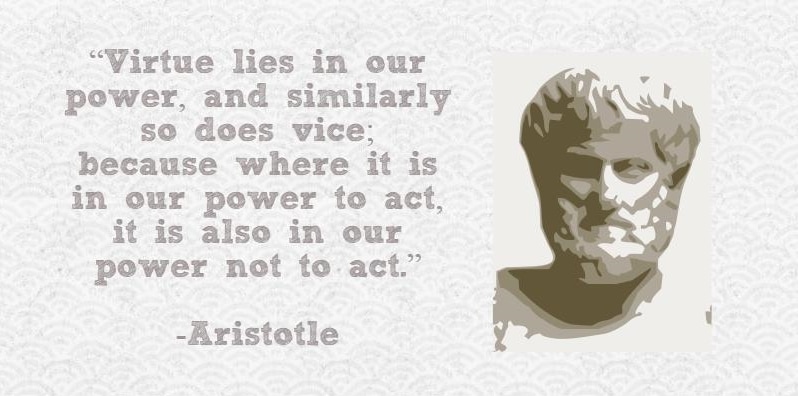
The word hexis in ancient Greek means an active condition of moral virtue. Hexis is a kind of striving or working to overcome our passive habituation by strength of character. To become good, Aristotle essentially thought that you need to "fake it 'till you make it." 

Hexis, or character, is defined as one's virtues or vices - not just any habit but something that affects when we feel pleasure or pain. Since moral virtue involves pleasure or pain, it is to our advantage to choose only those actions which don't cause us pain. We become well habituated by performing virtuous actions over time. These virtuous actions become real virtue when we start to choose them deliberately - when we are motivated by internal good. 


Recently my friend Dr. Greg Sadler launched the first in a series of new 45-minute webinars and in-depth online seminars developed and hosted by ReasonIO. His March webinar - which I participated in - introduces the basics of Aristotle's ethics. The video provides a short overview for those like me, who want to learn more about virtue ethics but don't have a ton of time to read. It's up on YouTube and I have embedded it below:


Read More
4 Comments
<<Previous
Forward>>

    Don't Miss A Post!

    Sign up to receive updates and special announcements!

    Thank You For Subscribing to Common Sense Ethics!

    You have successfully joined my email list. 

    .
    Picture

    About Me:

    Thank you for your interest in Common Sense Ethics! I'm Leah, a librarian and author with a background in history and philosophy.
    ​

    Most Popular Blog Posts:

    3 Unpopular (But Likely Correct) Opinions According to Cicero

    Beauty in Philosophy, Ethics and Art: A Conversation with David Fideler

    5 Ways to Counterbalance an Ugly and Barren Cultural Landscape

    How Propaganda Makes us Psychologically Totalitarian

    5 Things That You Need to be Happy According to Cicero

    5 Wholesome Character Education Books to Read to Your Child

    Why is Politics so Divisive?

    9 Great Critical Thinking Books for Children and Teens

    Why You Should Create Your Own Culture to Be Happier

    How to Make Yourself Immune to Propaganda

    ​The 10 Best Philosophy Books For Beginners

    The 13 Types of Modern Stoics...Which One Are You?

    How to be a Badass According to Cicero

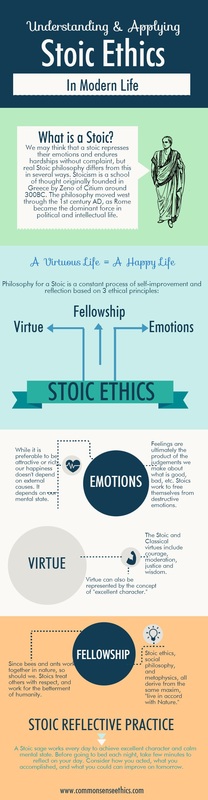
    Quick Guide: Understanding and Applying Stoic Ethics in Modern Life

    Download My Stoic Printables For Tough Days:

    Picture

    Watch Common Sense Ethics On YouTube:


    Support CSE:

    Picture
    Picture
    Buy Me a Coffee at ko-fi.com


    Topics:

    All
    According To Cicero Series
    Aesthetics
    AI Ethics
    Alasdair Macintyre
    Albert Einstein
    American Revolution
    Ancient Greece
    Ancient Rome
    Anger
    Antiauthoritarianism
    Applied Philosophy
    Aristotle
    Assertiveness
    Beauty
    Book Reviews
    Books And Reading
    Buddhism
    Carl Jung
    Cause And Effect
    Character Flaws
    Christianity
    Cicero
    Classical Education
    Cognitive Bias
    Consequence Based Ethics
    Consumerism
    Cosmology
    Covert Manipulation
    Critical Thinking
    Culture
    Cynicism
    Death
    Descartes
    Destructive Behavior
    Economics
    Edmund Burke
    Education
    Egalitarianism
    Emotions
    Environmentalism
    Epictetus
    Ethical Objectivism
    Family
    Fortitude
    Francis-bacon
    Freedom
    Freedom Of Speech
    Free Speech
    George-r-r-martin
    George-r-r-martin
    God
    Golden Rule
    Good Character
    Government
    Gratitude
    Grief
    Happiness
    Heraclitus
    History
    Immanuel Kant
    Individual Rights
    Information Literacy
    Inner Life
    Integrity
    Introspection
    Intuition
    Iron Law Of Oligarchy
    Jaques Ellul
    John Locke
    John Sellars
    John Stuart Mill
    Jules Evans
    Karma
    Left-right Brain Balance
    Left-right Political Spectrum
    Leisure
    Liberal Democracy
    Literature
    Logic
    Marcus Aurelius
    Marriage
    Marx
    Mastering Emotion
    Media
    Metaethics
    Mindfullness
    Moderation/temperance
    Modern Stoicism
    Moral Relativism
    Moral Universalism
    Mortality
    Movies
    Musonius Rufus
    Musonius-rufus
    Natural Law
    Natural Rights
    Natural World
    Nature
    Negative Freedom
    Negative-rights
    Neoplatonism
    Non Aggression
    Normative Ethics
    Normative-ethics
    Objectivismsubjectivism
    Oligarchy
    Parenting
    Perennialism
    Personal Development
    Philosophy For Beginners
    Pierre Hadot
    Plato
    Politics
    Propaganda
    Psychology
    Pythagoreanism
    Relaxed Mental State
    Renaissance
    Responsibility
    Rhetoric
    Right Vs. Wrong Actions
    Robert Nozik
    Roger Scruton
    Self Defense
    Self Discipline
    Seneca
    Sexuality
    Simple Living
    Socrates
    Socratic Method
    Stoicism
    Stoic Meditation
    Stoic Virtues
    Television
    The Shadow
    Thomas Hobbes
    Traditionalism
    Trivium
    Utilitarianism
    Videos
    Violence
    Virtue Ethics
    War
    Work

    Archives:

    March 2026
    February 2026
    January 2026
    November 2025
    October 2025
    September 2025
    July 2025
    May 2025
    April 2025
    April 2024
    March 2024
    February 2024
    January 2024
    December 2023
    November 2023
    October 2023
    September 2023
    August 2023
    July 2023
    June 2023
    May 2023
    April 2023
    March 2023
    February 2023
    January 2023
    December 2022
    November 2022
    October 2022
    September 2022
    August 2022
    July 2022
    June 2022
    May 2022
    April 2022
    March 2022
    February 2022
    January 2022
    December 2021
    November 2021
    October 2021
    September 2021
    August 2021
    July 2021
    June 2021
    May 2021
    April 2021
    March 2021
    February 2021
    January 2021
    December 2020
    November 2020
    October 2020
    September 2020
    August 2020
    July 2020
    June 2020
    May 2020
    April 2020
    March 2020
    February 2020
    January 2020
    December 2019
    November 2019
    October 2019
    September 2019
    August 2019
    July 2019
    June 2019
    May 2019
    April 2019
    March 2019
    February 2019
    January 2019
    December 2018
    November 2018
    October 2018
    September 2018
    August 2018
    July 2018
    June 2018
    May 2018
    April 2018
    March 2018
    February 2018
    January 2018
    December 2017
    November 2017
    October 2017
    September 2017
    August 2017
    July 2017
    June 2017
    May 2017
    April 2017
    March 2017
    February 2017
    January 2017
    December 2016
    November 2016
    October 2016
    September 2016
    August 2016
    July 2016
    June 2016
    May 2016
    April 2016
    March 2016
    February 2016
    January 2016
    December 2015
    November 2015
    October 2015
    September 2015
    September 2014
    August 2014
    June 2014
    May 2014
    April 2014
    March 2014
    February 2014
    January 2014
    December 2013
    November 2013
    September 2013
    August 2013


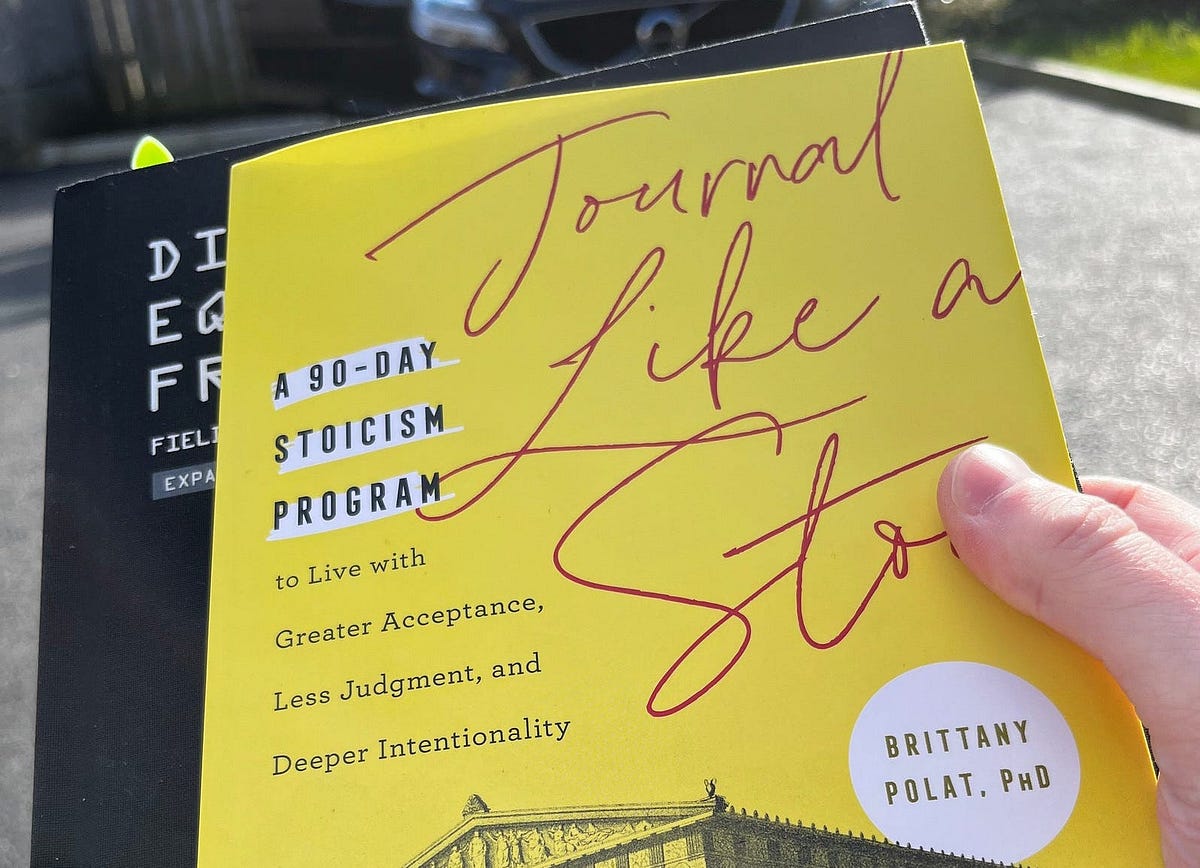
    ​Book of the Month: Journal Like a Stoic by Brittany Polat

    Picture


    ​Personal Growth Resources:

    Picture
    Use this in-depth questionnaire to learn more about your faults and subconscious motivations.


    Understanding and Applying Stoic Ethics In Modern Life:

    Picture


    ​Follow Common Sense Ethics on Pinterest:

    Picture


    ​Join the Stoic Parents Facebook Group:

    Picture
Powered by Create your own unique website with customizable templates.